Process Overview
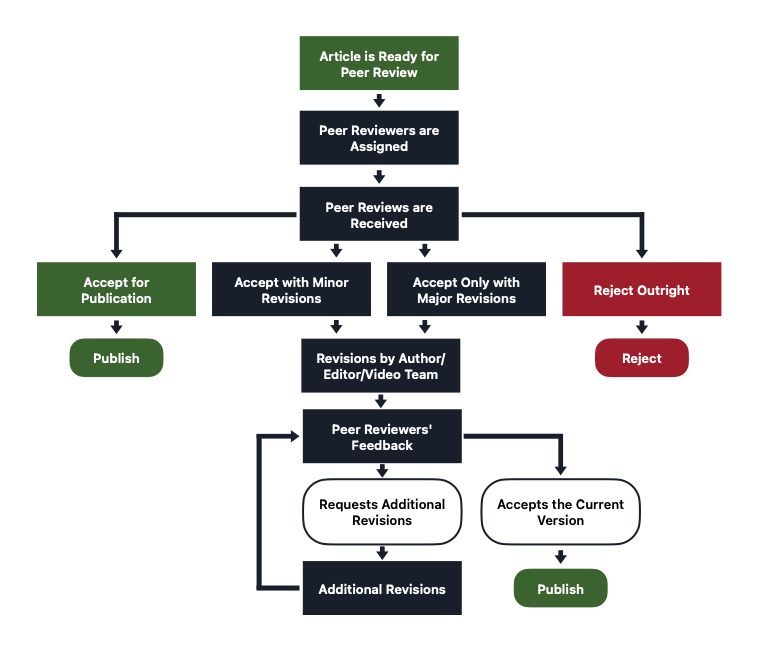
Once the internal review is complete, the Peer Review Manager selects and invites at least two experts to serve as peer reviewers for both the video and text components of the submission. JOMI follows a single-blind peer review process, where reviewers are aware of the authors’ identities, but authors do not know the reviewers’ identities. This ensures an unbiased evaluation while allowing reviewers to assess the work within the appropriate academic and clinical context.
Criteria for Peer Reviewer Selection:
- Must be an established surgeon with expertise in the relevant surgical subspecialty.
- Should have authored or co-authored peer-reviewed publications on the same or a closely related topic.
- Must have no conflicts of interest related to the authors, institutions, or funding sources of the submission.
- Should not be affiliated with the same institution or hospital as the submitting authors to maintain impartiality.
- Preference may be given to reviewers with prior peer review experience or editorial board memberships (excluding JOMI’s editorial board members).
Peer Review Process
Each invited reviewer evaluates the submission based on scientific rigor, evidence-based medical standards, educational value, technical accuracy, and clinical relevance. Reviewers are expected to provide comprehensive, constructive feedback aimed at ensuring scholarly integrity and improving the clarity, completeness, and overall impact of the article.
Once at least two independent reviews have been received, the Peer Review Manager compiles the reviewer feedback and shares it with the authors. In cases where the initial two reviews present significantly conflicting opinions, additional reviewers may be invited to ensure a balanced assessment.
Author Revisions and Response
If revisions are required, the authors are given a chance to address reviewer concerns and improve their submission. Authors are expected to provide a detailed response to each reviewer’s comments, highlighting changes made or providing justifications for maintaining specific elements. The revised submission is then re-evaluated by the original reviewers or, if necessary, by additional experts to determine whether the article meets JOMI’s publication standards.
This structured and rigorous review process ensures that all published content maintains high educational and clinical standards, contributing to JOMI’s mission of advancing surgical education through peer-reviewed video articles.
Expectations of Reviewers
Peer reviewers play a critical role in maintaining the scientific integrity, educational quality, and clinical relevance of the journal. Reviewers are expected to provide objective, constructive, and timely evaluations that help editors make informed publication decisions and assist authors in improving their work.
When reviewing a submission, reviewers should evaluate the following:
- Scholarly quality and scientific context. Evaluate whether the accompanying manuscript appropriately supports the educational content with accurate scientific information, relevant literature, and sufficient clinical context. Consider whether the authors adequately explain the rationale for key decisions, acknowledge important limitations or areas of uncertainty, and present conclusions that are consistent with the evidence provided.
- Clinical accuracy and standard of care. Assess whether the patient management, operative strategy, and surgical techniques are consistent with current standards of care, accepted clinical practice, and, where applicable, published guidelines. If the submission describes an innovative or non-standard approach, reviewers should consider whether the rationale is adequately justified and supported by available evidence.
- Clarity and quality of presentation. Evaluate whether the video and accompanying manuscript clearly and accurately communicate the procedure, including patient presentation, operative steps, anatomical landmarks, decision-making, and postoperative outcomes. Reviewers should identify areas where additional explanation, clarification, or improved organization would enhance understanding.
- Educational value. Consider whether the submission provides meaningful educational benefit to healthcare professionals. The content should present important technical concepts, operative decision-making, or clinical insights that contribute to continued medical education and professional practice.
- Balance and objectivity. Determine whether potentially controversial aspects of patient management or surgical technique are presented fairly and without bias. Alternative approaches, limitations, and relevant evidence should be discussed when appropriate, allowing readers to understand differing perspectives within current surgical practice.
- Recommendations for improvement. Provide specific, actionable comments that will help authors strengthen the scientific and educational quality of their submission prior to publication. Recommendations should be constructive, respectful, and supported by appropriate reasoning whenever possible.
- Confidential comments to the Editor. Reviewers may provide confidential comments intended solely for the editorial team. These comments may address concerns regarding scientific integrity, ethical issues, originality, conflicts of interest, or other matters that should not be communicated directly to the authors.
Peer Review of Animations
When an educational animation is included with an article, it is evaluated as part of the peer review process to ensure that it accurately supports the surgical video, manuscript, and educational purpose of the article.
Reviewers may be asked to evaluate the animation according to the following criteria:
- Accuracy. Does the animation accurately represent the operative steps, anatomy, instrumentation, and procedural sequence shown or described in the article?
- Completeness. Are all essential steps included, and have any unnecessary, inaccurate, or misleading elements been added?
- Clarity and Educational Value. Is the animation clear, concise, easy to follow, and does it add meaningful educational value?
- Clinical Concerns. Are there any omissions, inaccuracies, deviations from standard of care, or other issues that may mislead viewers?
- Professionalism and Confidentiality. Reviewer comments should be objective, constructive, and confidential, consistent with the standards that apply to all peer review activities.
Animation-related comments are addressed alongside other reviewer comments during revision. If substantive revisions are made, revised animations may undergo additional review to confirm that reviewer concerns have been satisfactorily addressed.
Peer Reviewer Responsibilities
Peer reviewers are expected to provide fair, impartial, and evidence-based assessments of submitted work, regardless of the authors’ institution, nationality, career stage, or personal characteristics. Reviews should be grounded in the reviewer’s clinical expertise, scholarly judgment, and the information presented in the submission.
- Reviewers should evaluate the scholarly, scientific, clinical, and educational value of the work and provide a clear basis for their opinion. They are not expected to identify every possible error or perform an exhaustive literature review, but they should determine whether the submission is accurate, educationally valuable, and suitable for publication in the journal.
- Reviews should be thoughtful, constructive, and respectful. Comments should focus on the content of the submission rather than the authors personally, and reviewers should avoid personal criticism or inappropriate remarks.
- Reviewers must maintain the confidentiality of the review process. Submitted materials should not be shared, discussed with third parties, distributed, or used for personal or professional advantage. Reviewers should not contact the authors directly regarding the submission.
- Reviewers must disclose any actual or potential conflicts of interest that could affect the objectivity of their review. If a conflict cannot be appropriately managed, the reviewer should decline the invitation.
- Reviews should be completed within the requested timeframe. If a reviewer is unable to complete the review on time, they should promptly notify the editor and, when appropriate, suggest alternative qualified reviewers.
- Reviewers should provide an overall recommendation using the decision framework requested by the editor.
- If a reviewer identifies potential concerns regarding originality or duplicate publication, they are requested to note this in their comments or confidential feedback to the editor, as articles submitted to JOMI must be original and not submitted or published elsewhere.
Peer Review Steps
1: Reviewer Reviews Video and Text
Reviewers utilize these text guidelines to understand the purpose of each subsection. However, if a reviewer thinks a section is too long or short and/or finds a typo, please comment.
Reviewers will watch the video article and make comments on the validity of technique or chaptering. If needed, reviewers may recommend to reject the video article.
2: Reviewer Provides Response / Feedback
Based on the criteria cited in the “Responsibilities” section (worth, quality, methodological rigor, utility, and publishability), the reviewer provides comments and gives one of the four below recommendations.
- Accept the Article for Publication - Move forward with printing, without changes
- Accept the Article with Minor Revisions - Move forward with printing, needs minor adjustments before printing
- Accept Only with Major Revisions - Must not be published until a major concern is addressed
- Reject for Publication Outright - Do not publish
Any comment may be designated “for JOMI staff only” in order to allow an honest discussion of the merits and weaknesses of the article.
3: JOMI Processes Review
All reviewer comments that are intended to be passed on to the authors of the article are passed on. If adjustments are made, repeat from Step 1.
4: Publication
Once the review is completed in a rigorous and satisfactory manner, the article is published on the JOMI site, and the authors are notified of the successful peer-reviewed status of their work.